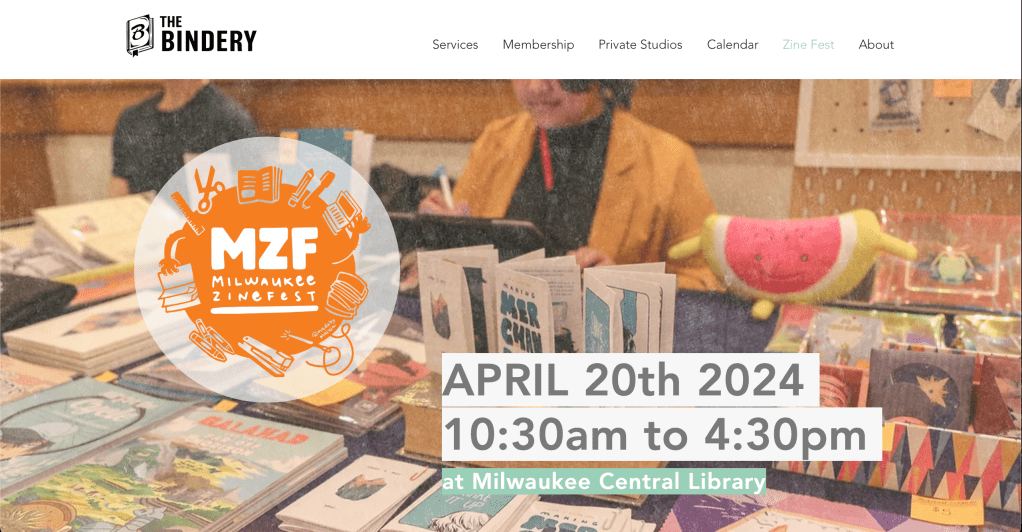
If I’m being honest, I had never even heard of a zine until my last year of undergrad. So somewhere around 2019-2020, right before the pandemic. I was fortunate to take a writing workshop focused solely on zines, and I was immediately drawn to them. Admittedly, I am not much of a visual artist, so my ability to produce them was somewhat limited, but the accessibility and ease to create and distribute ones own work is incredible. I was not surprised then to learn that the majority of “popular” zines are distributed by “zinesters” from marginalized groups. Our professor highlighted a lot of work from artists representing the LGBTQ+ community, and I was blown away to learn that many cities, including Milwaukee (as linked in the image above,) hold zine events to share, buy, sell, and trade zines from all over the world. All of this was topped off by my stumbling across zines for sale at Liliput Records on Farwell, a place I had frequented before to purchase music, but never noticed the collection of little booklets for sale. This experience really highlighted the intersection of music and literature for me, and since then I have had a great appreciation for zines, the “mixtapes” of literature. Similar to musicians putting together demos of their music, writers can now produce their own samples of work in the style of zines and distribute them with little cost to get their work out putting some of the power back in the hands of the people.
As far as my own experience with digital media goes, I write a lot of poetry and music, which in its own way could certainly take on different multimodal forms. I also worked with one of my good friends on a video essay he eventually submitted to the Milwaukee Film Festival, which played as part of a collection for graduating film students. I produced the music and wrote the script while he filmed and edited the video and I can honestly say it was probably one of my favorite projects I have ever worked on. (Side note- I wanted to score movies before I even knew it was called “scoring” movies, so that process was something I genuinely enjoyed doing.) The combination of creative expression and communal effort was the perfect environment for me! I feel like music accesses a part of human emotion that written words cannot do on their own, and the combination of sound and visuals in multimodal forms allows for a deeper sense of expression. With that, here is a link to some music getting me through the week!
Going forward, I like the ideas discussed by Buchanan on Zines in the Classroom. Whether as supplemental material to texts, stand alone reading material, or as a unit in which students create their own, zines have proven to be diverse and rich in application. As Buchanan says on page 71, “The key is finding texts that engage and motivate students to become involved with the written word. Zines provide a way to motivate students. They are visually appealing, and they are easy to hold, manipulate, and access. They present short, attention-getting narratives, and they are written in language and vernacular most students understand and appreciate. Students can interact with zines and zine creators in personal ways, creating a sense of involvement and connection not found in traditional stories and texts. All the elements of zines and the zine culture make for engaging, multimodal literacy projects for both students and teachers.” Zines, and other forms of multimodal expression are deeply engaging and offer students new and interesting ways to express themselves and their ideas. I hope to utilize these forms as often as possible to allow my students as much room to play and discover their own unique voices!
 Check Your Tone
Hey Anthoni, I love the images and link you embedded. Milwaukee is an amazing place for many things–music, zines, film, etc.–and your personal connection with a multimodal project with your friends is a wonderful culmination of these elements.
LikeLike
The phrase “the mixtapes of literature” is great. And every week, I learn something new about you and I am amazed, you wanted to create scores for movies?! That’s awesome. Zines are a great way to expand the horizons of the more “not talked about” side of a city. Like in Milwaukee, I did not know about the selling and buying of zines until you told me. That transaction is great and I hope the creation of zines translate into your future classroom backed by a beautiful score.
LikeLike
I too found a love for zines, and I like your description of them as the “mixtapes of literature,” very true! Also, I find it so cool that you had the chance to produce and write a script for a film!!! That is something that I too have been interested in!
LikeLike
Hello Anthoni,
I agree whole-heartedly that zines can readily connect with students. I didn’t know what zines were before this chapter, and after about 30 minutes of browsing the interweb, I found a collection of zines that speak to me. They could be a phenomenal classroom resource to engage students in literature. I think your creative writing background could have a field-day with this in a classroom.
LikeLike